A Modern Reimagining of Homer’s Epic
Arranged by Avi Harel, ergolight@gmail.com
Abstract
This article examines Kostas Kartelias’ poem The Odyssey as a modern, introspective reimagining of Homer’s epic. Rather than retelling the heroic adventures literally, Kartelias transforms the episodes into psychological and existential states. By mapping selected poems onto Homeric books, this study identifies recurring motifs of guilt, temporality, survival, identity, and existential exposure, highlighting the poem’s focus on consciousness rather than narrative resolution.
Introduction
Homer’s Odyssey is one of the most influential epics in Western literature, chronicling Odysseus’ journey home from Troy. In contrast, Kostas Kartelias’ The Odyssey (Greek: Η Οδύσσεια) does not aim for narrative fidelity. Instead, Kartelias engages in a poetic dialogue with Homer, using the epic as a scaffold to explore human consciousness. Each poem transforms episodes of the journey into internal states, emphasizing moral ambiguity, memory, identity, and vulnerability.
- The Trojan Prelude: Guilt and Predestination
The poem opens with Η Ωραία Ελένη (Helen the Beautiful), invoking the cause of the Trojan War. This establishes consciousness burdened by collective guilt and the inevitability of the journey, portraying the hero as lacking initial agency. Kartelias reframes external historical causes as internal psychological landscapes. - Thaca and Waiting: Temporal Stasis
Το τραγούδι της Πηνελόπης (Penelope’s Song) exemplifies a frozen, suspended consciousness. Waiting and loyalty are experienced not as actions but as a suspended state of being. Ithaca becomes a mental space of longing rather than a physical destination. - Calypso and the Sea: Survival and Drift
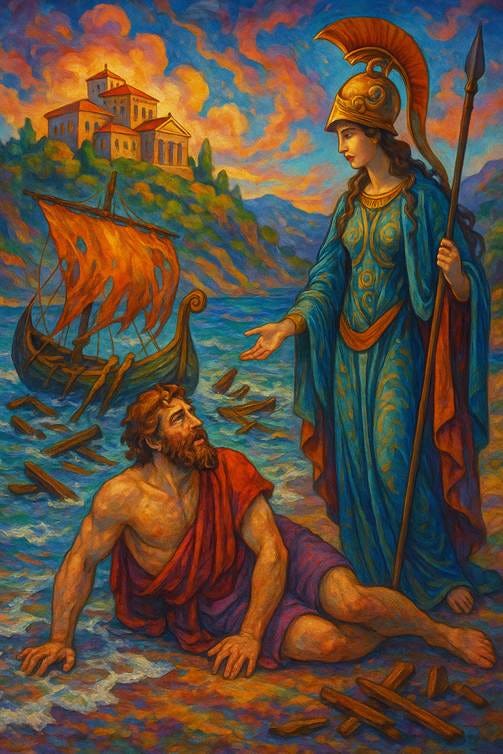
Poems such as Στην Καλυψώ (At Calypso), Ναυαγός (Shipwrecked), Θάλασσα μάγισσα (Sea Witch), and Δίπλα στη θάλασσα (By the Sea) depict consciousness adrift, threatened by the unpredictability of external forces. The sea symbolizes uncontrollable circumstances, while Calypso embodies the seductive pull of stasis, tempting the subject to forsake human agency. - Nausicaa: Compassion and Rebirth
Στη Ναυσικά (With Nausicaa) presents a moment of vulnerability and recognition. Consciousness is reborn through relational awareness and empathy, demonstrating that the self is constructed through encounters with others. - Threats to humanity: Cyclops, Circe, and Companions
Σαν το θηρίο (Like a Beast), Κίρκη (Circe), and Το τραγούδι των Συντρόφων (Song of the Companions) explore fear, moral ambiguity, and collective responsibility. The Cyclops and Circe serve as projections of internalized threats, while companions reflect the fragility of moral cohesion. - The Underworld: Memory and the Dead
Στον κάτω κόσμο (In the Underworld) symbolizes confrontation with irretrievable pasts. Memory and trauma shape consciousness, demonstrating the inseparability of the self from history and loss. - Sirens: Temptation and Tragic Choice
Το τραγούδι των Σειρήνων (Song of the Sirens) and the continuation of Το τραγούδι των Συντρόφων depict awareness facing deliberate peril. Consciousness chooses between unavoidable evils, highlighting the tension between knowledge and moral action. - Identity Lost: Fragmented Self
Χωρίς ταυτότητα (Without Identity) portrays the self as dispersed. Disguise and alienation prevent recognition, reflecting the impossibility of a complete homecoming. Kartelias’ Odysseus cannot regain a singular, unified identity. - Love as Divine Force: Surrender
Ο έρωτας θεός (Love as God) presents love as an overwhelming, divine-like force. Consciousness surrenders to attraction and relational forces that are simultaneously creative and destabilizing. The poem ends with exposure rather than resolution.
Kartelias view of Homer's epic
Conclusion
The Songs of Odysseus by Kostas Kartelias transform the Homeric episodes into explorations of human consciousness. Each poem corresponds to a Homeric book, yet the focus is inward: on moral ambiguity, identity, memory, and vulnerability.
While Homer emphasizes heroic action and narrative closure, Kartelias foregrounds existential experience, demonstrating that the journey is less about physical return than navigating the internal landscapes of selfhood.
References
Bassnett, S. (2013). Translation studies (4th ed.). London: Routledge.
Finley, M. I. (1954). The world of Odysseus. New York, NY: Viking Press.
Homer. (1965). The Odyssey (R. Lattimore, Trans.). Chicago, IL: University of
Chicago Press.
Homer. (1996). The Odyssey (R. Fagles, Trans.). New York, NY: Penguin.
Kartelias, K. (n.d.). Η Οδύσσεια / The Odyssey [Selected poems].
Lefevere, A. (1992). Translation, rewriting, and the manipulation of literary
fame. London: Routledge.
Nagy, G. (1979). The best of the Achaeans: Concepts of the hero in archaic Greek
poetry. Baltimore, MD: Johns Hopkins University Press.